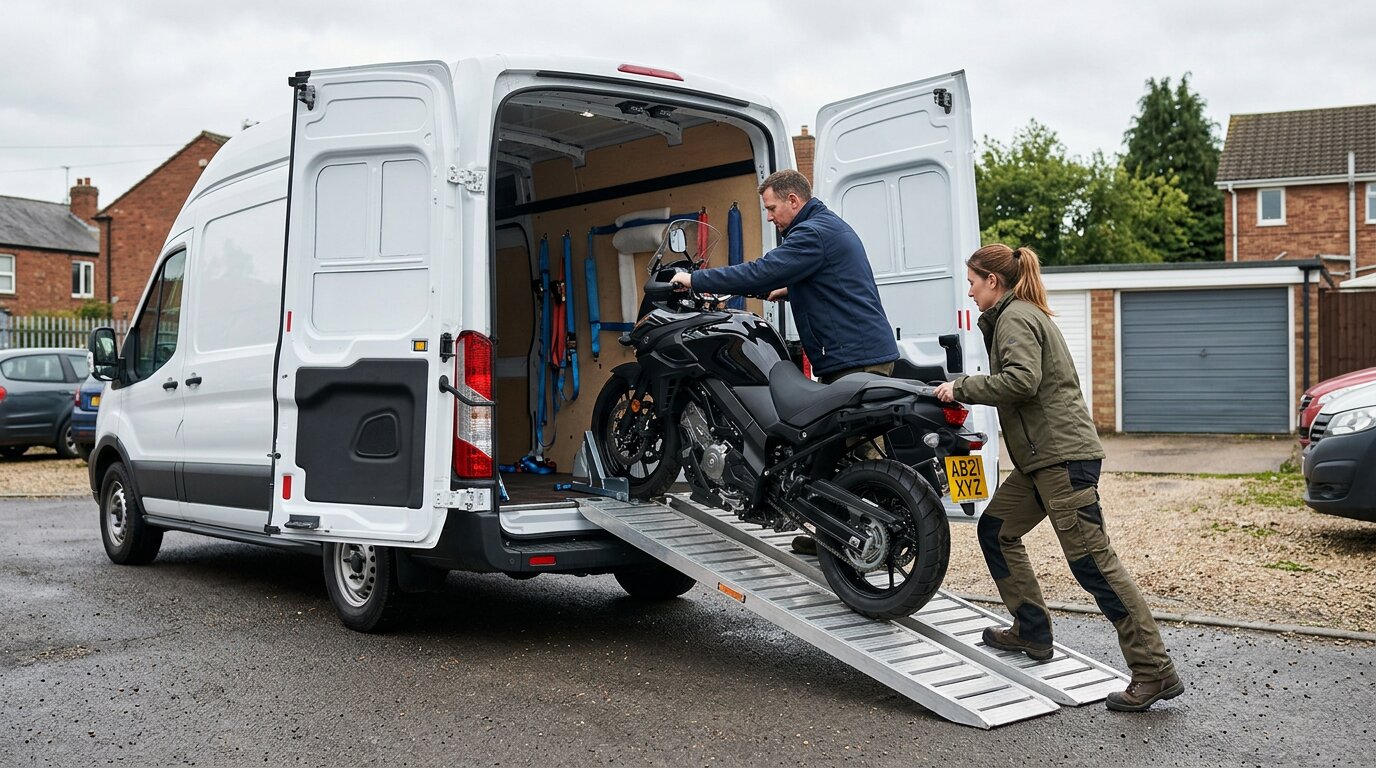
Buying a bike that’s too far to ride home, or that isn’t road-legal yet, often ends with the same plan: hire a van for the day and bring it back yourself. It works well when three things line up. The bike physically fits through the doors and into the load area. The hire company is happy for you to carry it. And you have the kit and the help to secure it properly.
Most of the problems people run into on collection day come from skipping one of those checks. The questions below take them in the order you’ll meet them.
Will the bike fit through the doors, not just in the back?
Load-area length gets all the attention, but the rear door opening is usually the tighter limit. A bike with a tall screen or high mirrors can clear the inside of a van and still catch on the top of the door frame on the way in. Handlebar width matters too, because you’ll want room to stand beside the bike while you strap it.
Take these measurements from the bike, or from the manufacturer’s specification if you can’t get to it before the day.
| Measure | The bike | Ask the hirer for | Why it matters |
|---|---|---|---|
| Overall length, tyre to tyre | ____ mm | Load floor length, bulkhead to rear doors | The bike must fit upright in a wheel chock or frame, with the doors closing clear of it |
| Height at the highest point (screen or mirrors) | ____ mm | Rear door opening height and internal height | The usual snag on the way in |
| Handlebar width | ____ mm | Width between the wheel arches | You need space to reach the tie-down points |
| Weight (manufacturer’s figure) | ____ kg | Payload of the specific vehicle | Bike, ramp, kit and passengers all count |
| Ground clearance or lowest point | ____ mm | Load-floor height at the rear | Low bikes can ground out where the ramp meets the van |
Hire websites often give indicative load lengths for each van size. Treat those as a guide and ask for the figures of the vehicle you’ll actually be given, since layouts differ between models.
Is carrying a motorcycle allowed under the hire agreement?
Don’t assume it is. Some hirers are relaxed about it. Others restrict what can be carried, or will charge for damage that a careless loading easily causes, such as a handlebar pushed through the ply lining and into the side panel. Ask directly, and get the answer in writing:
- Can a motorcycle be carried in the load area?
- Are there tie-down points on the floor or walls, and how many?
- Does the hirer supply a ramp, straps or a wheel chock, or do you bring your own?
- Who pays if the lining or floor is marked, and what is the insurance excess?
- Can the van be delivered to you, or must you collect it?
Check the van’s weight too. A standard category B car licence covers vehicles up to 3,500kg maximum authorised mass for petrol and diesel, according to GOV.UK’s licence categories page.
How should the bike be secured once it’s in?
This is the part not to improvise. The DVSA’s guide to securing loads on goods vehicles says a dedicated motorcycle trailer should be used if possible. Otherwise, a motorcycle can be carried in a box or cage strapped down to the load bed, or chocked or placed in a frame and lashed to the vehicle. The same guide’s section on vans says there must be a usable bulkhead between the load and the cab, and that large or heavy items should be secured to the vehicle.
The Highway Code’s rule 98 also says you must secure your load and must not overload the vehicle. In practice that means a front wheel chock or a purpose-made frame, lashed to suitable rated anchor points in the load area with ratchet straps rated for the job, soft loops so hooks don’t scratch the bike, and padding where the bars or levers sit near the van wall. Recheck the straps after the first few miles. If you’re unsure about strap points on your particular model, ask the seller or a dealer before the day, not in the car park.
Who can I ask about a van near Helensburgh?
If the collection or your home is on the Clyde coast, one place to make an enquiry is the page for van availability in Helensburgh. It’s written mainly for trade and business hire, so say up front that you’re a private customer collecting a motorcycle, and run through the permitted-use questions above.
The page lists vehicle types from small vans up to Lutons, and also a recovery van. If a bike is non-running or awkward to push, ask whether a recovery-type vehicle is available for your use and what licence and experience it would need. Routes from Helensburgh towards Glasgow may enter a low emission zone. Scotland has four, in Aberdeen, Dundee, Edinburgh and Glasgow, enforced by number-plate cameras, according to mygov.scot, so confirm the van meets the standard if your route takes you into one.
What about collecting a bike around Bradford?
For collections in West Yorkshire, there is van hire information for Bradford, which lists panel vans in several wheelbases, Lutons and crew vans. Use it to compare the stated load lengths against your measurement sheet, then confirm the exact vehicle and its door opening before you book.
One local point is worth knowing. Bradford Council’s Clean Air Zone page says cars and motorbikes don’t pay, but vans might if they don’t meet the clean air rules. If your route crosses the zone, ask the hirer whether the van is compliant, or check its number plate on the council’s checker once you know which vehicle you’re getting.
What should happen on collection day itself?
A hypothetical sequence that tends to go smoothly:
- Photograph the van’s load area and lining before anything goes in.
- Arrive with a helper. One person steers from beside the bike while the other pushes.
- Check the paperwork with the seller before loading, not after.
- Load, chock, strap and pad. Rock the bike firmly to test it.
- Stop after a few miles to recheck the straps.
- At home, unload before returning the van, sweep out any grit or fluid, and photograph the empty load area again.
Plan the return time with slack. Unloading a bike alone after dark is an easy way to drop it or dent a panel.
Is a van always the right answer?
Not always. For a very tall adventure bike, a heavy tourer or a non-runner with seized brakes, a specialist motorcycle transporter may cost less than a day’s hire plus a damage charge. A van is a good fit when the bike rolls, your measurements leave clear margin, the hirer has said yes in writing, and you’ve got the straps and the second pair of hands sorted before you set off.